We Audited 312 Startup Websites. Here's What Most of Them Get Wrong (2026 Study)
We ran Verdy's audit on 312 startup and indie product websites in October 2026, 256 of them launched on Show HN that month. The median site scored 69 out of 100, one in three scored under 50, and only one in four had all ten basics we check. The most common gaps were missing structured data (51 percent of sites), too little text for search engines to quote (44 percent), no sitemap (33 percent) and no link preview image (24 percent).
- The median startup website scored 69 out of 100. One in three scored under 50 and fewer than one in five scored 90 or more.
- Only 25 percent of sites had all ten basics in place, from a page title and meta description to a sitemap and structured data.
- Half the sites (51 percent) had no structured data at all, so search engines and AI assistants have to guess what the product is.
- One in four shared links with no preview image, and one in three had no sitemap.
- 8 percent blocked AI crawlers such as GPTBot in robots.txt, usually without meaning to.
- Sites launched on Show HN in October scored lower (median 69) than the indie sites we reviewed in August (median 74).
#Why we ran this study
Founders ask us the same question in different words: is my site actually ready, or am I about to launch something Google and ChatGPT can't read? We had the tool to answer it at scale, so we pointed it at a few hundred real launches and counted.
This page reports what we found, how we found it, and what each number means for your own site. Every figure below comes from the same audit you can run free at /audit. We don't name any site that scored badly; the point is the pattern, not the people.
#How we did it
We audited 353 websites between October 30 and October 31, 2026. 312 returned a full result. The other 41 timed out (22), couldn't be reached (18) or showed no readable content without JavaScript (1).
The sites came from two groups:
- 256 sites launched on Show HN in October 2026. We took every Show HN post from October 1 onwards with at least 5 points and a link to the product's own website, using the public Hacker News search API.
- 56 indie product sites we first reviewed in August 2026, audited again with the current version of the audit.
We left out links to platforms rather than a maker's own site: GitHub, app stores, the Chrome Web Store, Steam, YouTube, Hugging Face, npm and similar. Each site was counted once, by domain.
For every site the audit read the homepage, crawled up to 12 pages, checked robots.txt, the sitemap, titles, descriptions, headings, canonical tags, structured data and social preview tags, and asked Google PageSpeed Insights for speed data. The score starts at 100 and drops for each problem found, weighted by severity. A site missing basics can't score at the top however clean the rest is.
#The headline numbers
| Result | Sites | Share |
|---|---|---|
| Scored 90 to 100 | 55 | 18% |
| Scored 80 to 89 | 54 | 17% |
| Scored 50 to 79 | 103 | 33% |
| Scored under 50 | 100 | 32% |
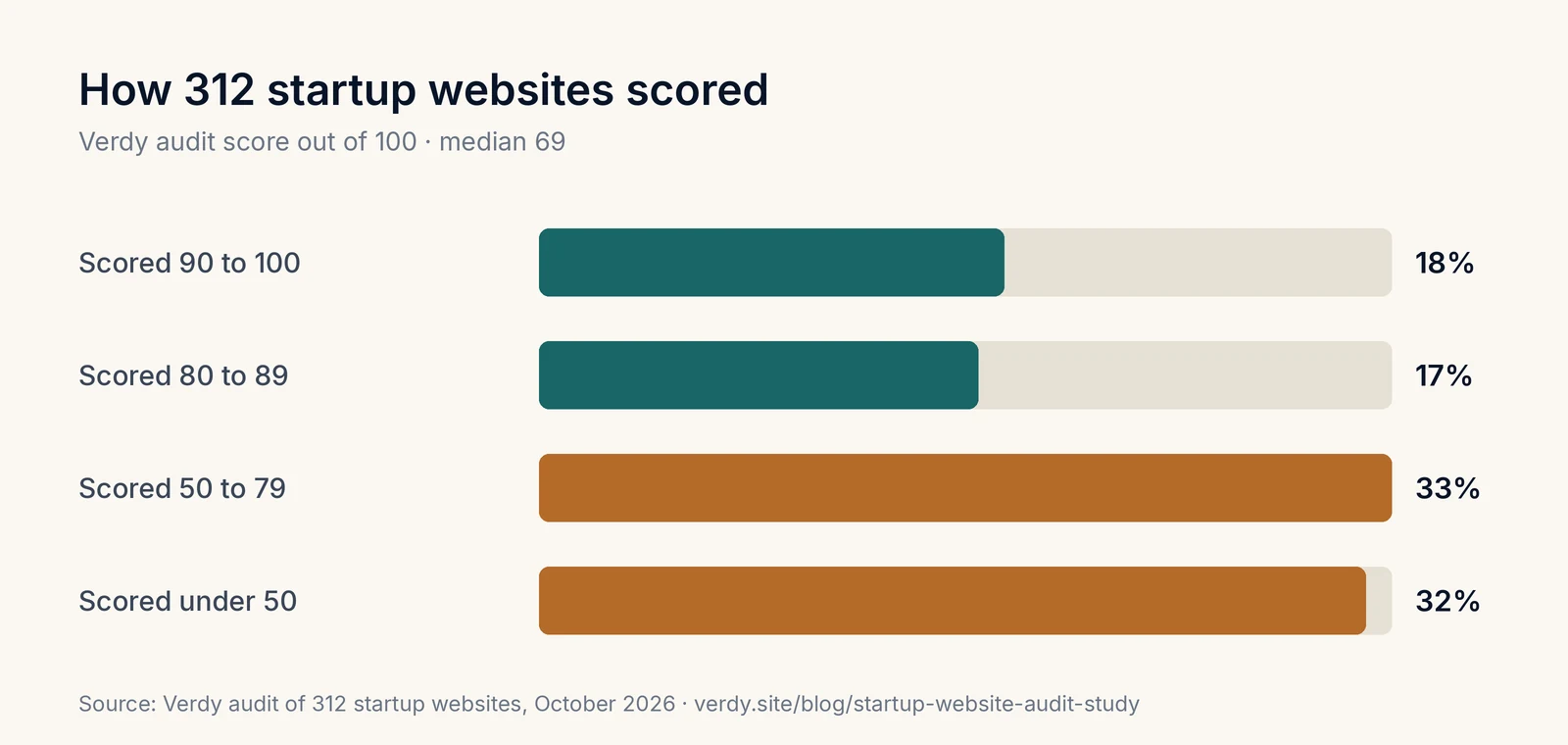
The median site scored 69 out of 100 and the average was 63. Only 25 percent of sites, 79 of 312, had all ten basics we check. And 23 percent showed search engines a single readable page, usually because the rest of the site only appears after JavaScript runs.
#What was missing most often
These are the ten basics, ordered by how many sites lacked each one.
| Basic | Sites missing it |
|---|---|
| Structured data (JSON-LD) | 51% |
| Enough text to quote | 44% |
| A sitemap | 33% |
| A canonical URL | 31% |
| A usable page title | 28% |
| A link preview image | 24% |
| More than one readable page | 23% |
| A robots.txt | 23% |
| A favicon | 11% |
| A meta description | 8% |
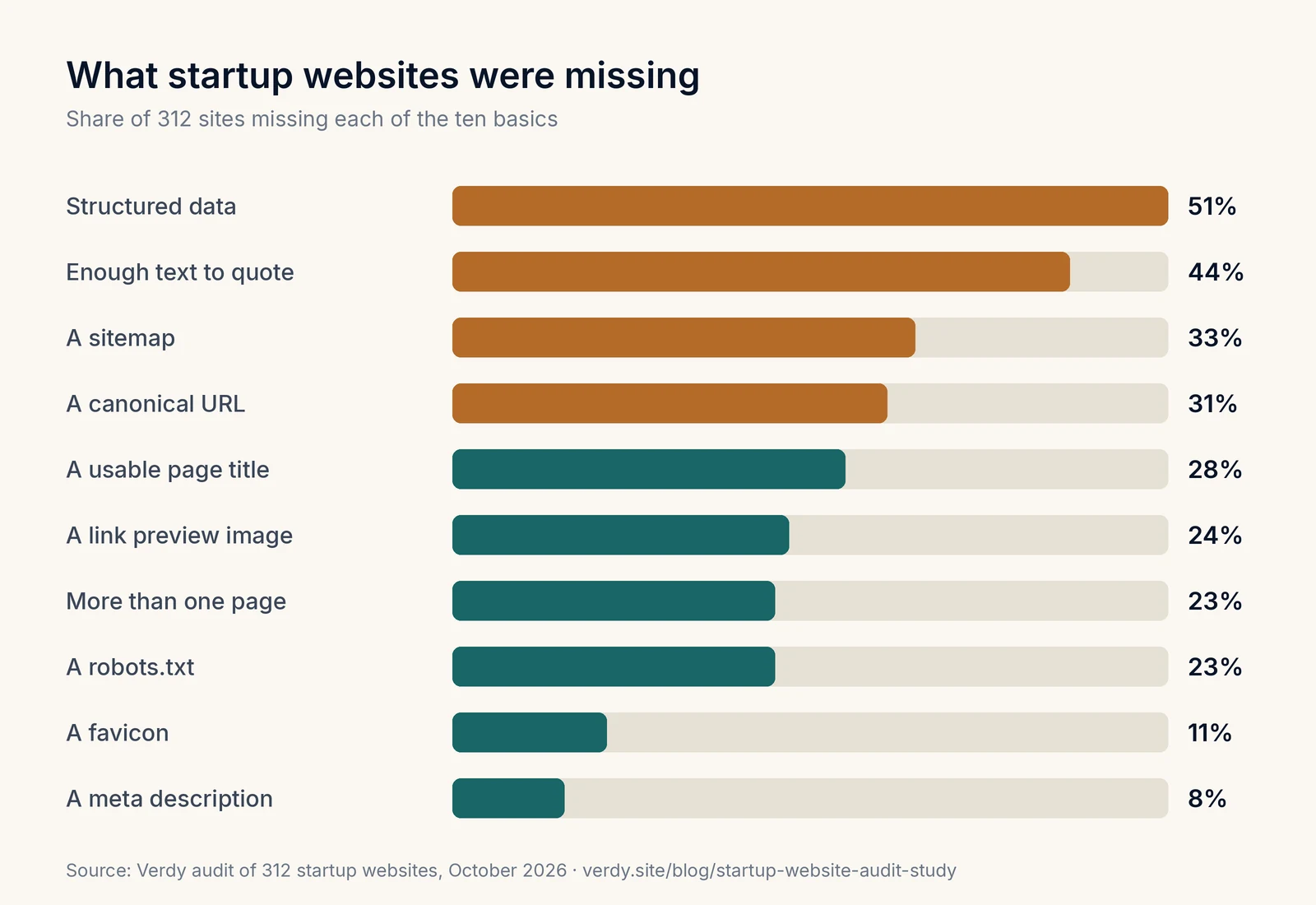
The meta description is the one basic almost everyone gets right, because most site builders add one by default. The ones near the top of the table take a deliberate step, and that's where launches fall short.
#Finding 1: half of startup sites have no structured data
51 percent of the sites had no structured data at all, and 30 percent never declared their social profiles in it. Structured data is a short block of JSON-LD that tells search engines, in their own vocabulary, that this page is a software product with a name, a price and a category.
Without it, Google can still index the page, but it has to infer what the product is from the text. Google's own documentation describes structured data as the explicit way to give it that information. For a SaaS homepage the right type is SoftwareApplication; our guide to SoftwareApplication schema has a block you can copy.
#Finding 2: too little text for anyone to quote
44 percent of sites didn't have enough text on the page to quote, and 41 percent had at least one crawled page with almost no text. Hero sections built from a headline, an animation and a button look good in a browser and give a crawler a dozen words.
Search engines and AI assistants rank and cite passages. If the page never says, in plain sentences, what the product does and who it's for, there is nothing for them to lift into an answer. Two or three short paragraphs below the fold fix most of it.
#Finding 3: one in four sites shares links with no preview image
24 percent of sites had no link preview image (the og:image tag), and 22 percent had no X card. When those sites are shared on X, LinkedIn, Slack or iMessage, the link shows as a bare URL or a grey box.
For a launch that lives on shares, that is the costliest gap on this list and one of the fastest to close. Our OG image size guide covers the 1200 by 630 image and the five tags that go with it.
#Finding 4: a third of sites have no sitemap
33 percent of sites had no sitemap, 31 percent had no canonical URL on the homepage and 23 percent had no robots.txt. None of these stop Google on its own, but together they decide how fast a new site gets discovered and which version of each page counts.
Google's sitemap documentation notes that sitemaps matter most for sites that are new and have few links pointing to them, which describes almost every site in this study. If your site is missing from Google, our guide on why a new website isn't showing up on Google walks through the checks in order.
#Finding 5: 8 percent block AI crawlers
8 percent of sites, about one in twelve, blocked AI crawlers such as GPTBot, ClaudeBot or PerplexityBot in robots.txt. It was the most common critical finding in the study.
In most cases it doesn't look deliberate: the block comes from a hosting template, a security plugin or a robots.txt copied from elsewhere. The effect is that assistants which respect robots.txt can't read the site when someone asks them for a recommendation. A small number of sites (2.6 percent) also had pages marked noindex, which keeps them out of Google entirely. Our guide on checking AI crawler access shows how to read your robots.txt in a minute.
#Finding 6: Show HN launches scored lower than the August group
The 256 Show HN sites had a median score of 69. The 56 sites from August had a median of 74, and a larger share of them scored 90 or more (13 of 56, against 42 of 256).
The likeliest reason is timing. A Show HN post often goes up the day a project first works, while the August group had been live for a while. If you're planning a launch, the gap is the argument for running a check a week before the post, not after it.
#What this means for your launch
The pattern is consistent: most sites aren't broken, they're unfinished. The fixes that would move the most sites are small and mostly one-time:
- Add
SoftwareApplicationstructured data to the homepage. - Write two or three plain paragraphs that say what the product does and who it's for.
- Add a 1200 by 630 preview image with the Open Graph and X card tags.
- Publish a sitemap and a robots.txt, and set a canonical URL on every page.
- Check robots.txt isn't blocking GPTBot, ClaudeBot or PerplexityBot unless you mean it to.
Our website launch checklist has the full list with the exact tags.
#Using this data
You're welcome to cite these numbers. Please link to this page as the source, and quote the sample with them ("312 startup websites audited by Verdy in October 2026"). If you need a breakdown we haven't published here, get in touch through the site and we'll share what we can, in aggregate.
#FAQ
#How many websites were in the study?
We audited 353 startup and indie product websites in October 2026, and 312 returned a full result. 256 of the 312 were launched on Show HN in October 2026, and 56 were indie product sites we first reviewed in August 2026.
#What is the most common SEO mistake on startup websites?
Missing structured data. 51 percent of the sites we audited had no JSON-LD at all, so search engines had to work out what the product was from the page text alone. The next most common gaps were too little text to quote (44 percent) and no sitemap (33 percent).
#What score did the average startup website get?
The median site scored 69 out of 100 and the average was 63. 18 percent scored 90 or more, and 32 percent scored under 50.
#How many startup websites block AI crawlers?
8 percent of the sites, about one in twelve, blocked AI crawlers such as GPTBot, ClaudeBot or PerplexityBot in robots.txt. Most blocks appeared to come from templates or plugins rather than a deliberate choice.
#How was the score calculated?
Each site starts at 100 and loses points for every problem the audit finds, weighted by severity. A site missing basics such as a sitemap or a preview image can't reach the top score, however clean the rest is. The audit reads the homepage, crawls up to 12 pages and uses Google PageSpeed Insights for speed.
#Are any of the audited sites named?
No. We report the results in aggregate only and don't name sites that scored badly. The sample method is described above so anyone can rebuild a similar list from the public Show HN data.
#Can I check my own site the same way?
Yes. The same audit is free at verdy.site/audit. It shows every finding with its severity, so you can compare your result with the numbers in this study.
#The bottom line
Across 312 startup websites, the typical site is two thirds of the way to ready. The gaps are rarely hard to fix: structured data, a few sentences of real text, a preview image, a sitemap and a robots.txt that lets the right crawlers in. Most founders never check because the site looks fine in a browser. Check before you launch, and you start ahead of most of the sites in this study.
Want to see where your own site lands against these 312? Run a free Verdy audit and get every finding, ranked by severity.
Run a free auditPrices, plans and platform rules change. Anything current in this guide was checked on October 31, 2026; confirm on the vendor's own site before you buy.